01/AtlasCore·UI v2
AtlasCore
Secure enterprise AI infrastructure for knowledge, retrieval, and grounded AI workflows.
- status
- UI v2
- role
- engineering
- focus
- FORCE RLS / hybrid retrieval / grounded AI / UI v2
- tests
- 717 backend · 46/46 evals
- commit
- 9d62e33 — ship AtlasCore UI v2
A multi-tenant AI platform for ingesting organisation knowledge, retrieving it under database-enforced access control, and answering questions only from retrieved evidence. Security is enforced in code and database boundaries rather than delegated to model prompts.
atlascore / workspace ui v2
→ FORCE RLS + restricted runtime DB role
→ Hybrid FTS + pgvector + RRF retrieval
→ Evidence-first Ask AI with abstention
→ Workspace selector and admin surfaces
product panel · capture real screenshots via npm run screenshots:atlascore
summary
AtlasCore is a multi-tenant AI platform for organisation knowledge, database-enforced retrieval, and grounded answering. Models operate inside backend, authorization, and evidence boundaries — not as the security boundary themselves.
problem
Enterprise AI workflows fail when tenant isolation is soft, when retrieval can leak across workspaces, or when models answer without inspectable evidence. Soft prompt instructions are not enough. Isolation, membership, and evidence sufficiency need to be enforced in code and in the database.
what i built
The current verified surface includes organisations and workspaces, invitations and teams, service accounts and API keys, knowledge ingestion, hybrid retrieval, grounded answering with citations and abstention, audit logging, provider configuration, and a Next.js workspace UI (v2).
organisations and workspaces · multi-tenant architecture · PostgreSQL Row-Level Security · FORCE RLS · restricted runtime database role · RBAC · secure authentication · workspace membership validation · invitations · teams · service accounts · API keys · knowledge sources and documents · ingestion pipeline · chunking · embeddings · PostgreSQL full-text search · pgvector
architecture
Requests flow through authenticated application services into workspace-scoped operations. Knowledge is ingested, chunked, and embedded; retrieval combines PostgreSQL full-text search with pgvector; answering is gated on evidence sufficiency. Isolation is enforced with FORCE RLS and a restricted runtime database role.
Architecture overview — UI v2
Workspace UI v2
- Grouped sidebar
- Workspace selector
- Ask AI + citations
- Org / workspace admin
Application services
- FastAPI
- Auth + RBAC
- Ingestion + retrieval
- Grounded answering
- Audit + observability
Tenant isolation
- Organisations / workspaces
- Live membership revalidation
- PostgreSQL RLS + FORCE RLS
- Restricted runtime DB role
Knowledge & retrieval
- Sources + documents
- Chunking + embeddings
- FTS + pgvector hybrid
- Reciprocal Rank Fusion
Not shipped: MCP, safe analytics SQL, workflow engine, tool registry, human approval gates, Gemini integration, or large-scale production deployment claims.
tenant isolation and security
Multi-tenant boundaries are modeled as organisations and workspaces. PostgreSQL Row-Level Security with FORCE RLS is a core isolation mechanism. The runtime database role is restricted. Workspace context fails closed. Organisation and workspace membership are revalidated live — no hardcoded workspace IDs. RBAC, invitations, teams, service accounts, and API keys sit on top of that foundation.
knowledge ingestion and hybrid retrieval
Knowledge sources and documents move through an ingestion pipeline with chunking and embeddings. Retrieval combines PostgreSQL full-text search and pgvector similarity, fused with Reciprocal Rank Fusion, so answers can draw from lexical and semantic matches under the same access controls that protect the underlying rows.

grounded answering
Ask AI is evidence-first: the system builds evidence packets, gates on sufficiency, abstains when evidence is weak or missing, validates citations, and applies prompt-injection heuristics. Trusted instructions are separated from untrusted retrieved evidence. Providers include a deterministic test provider plus OpenAI, Anthropic, and configurable OpenAI-compatible base URLs. Provider secrets are not logged.
workspace ui v2
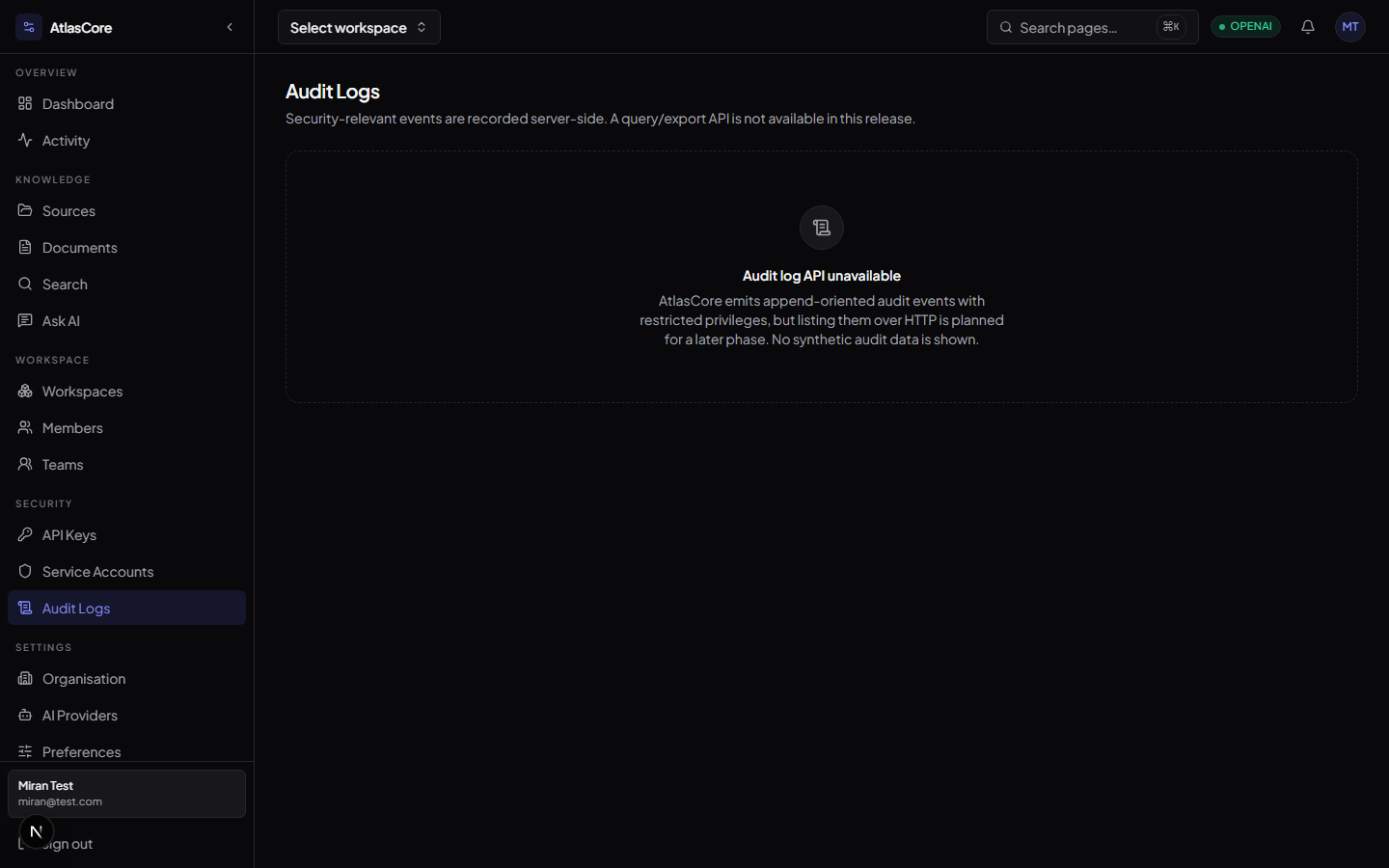
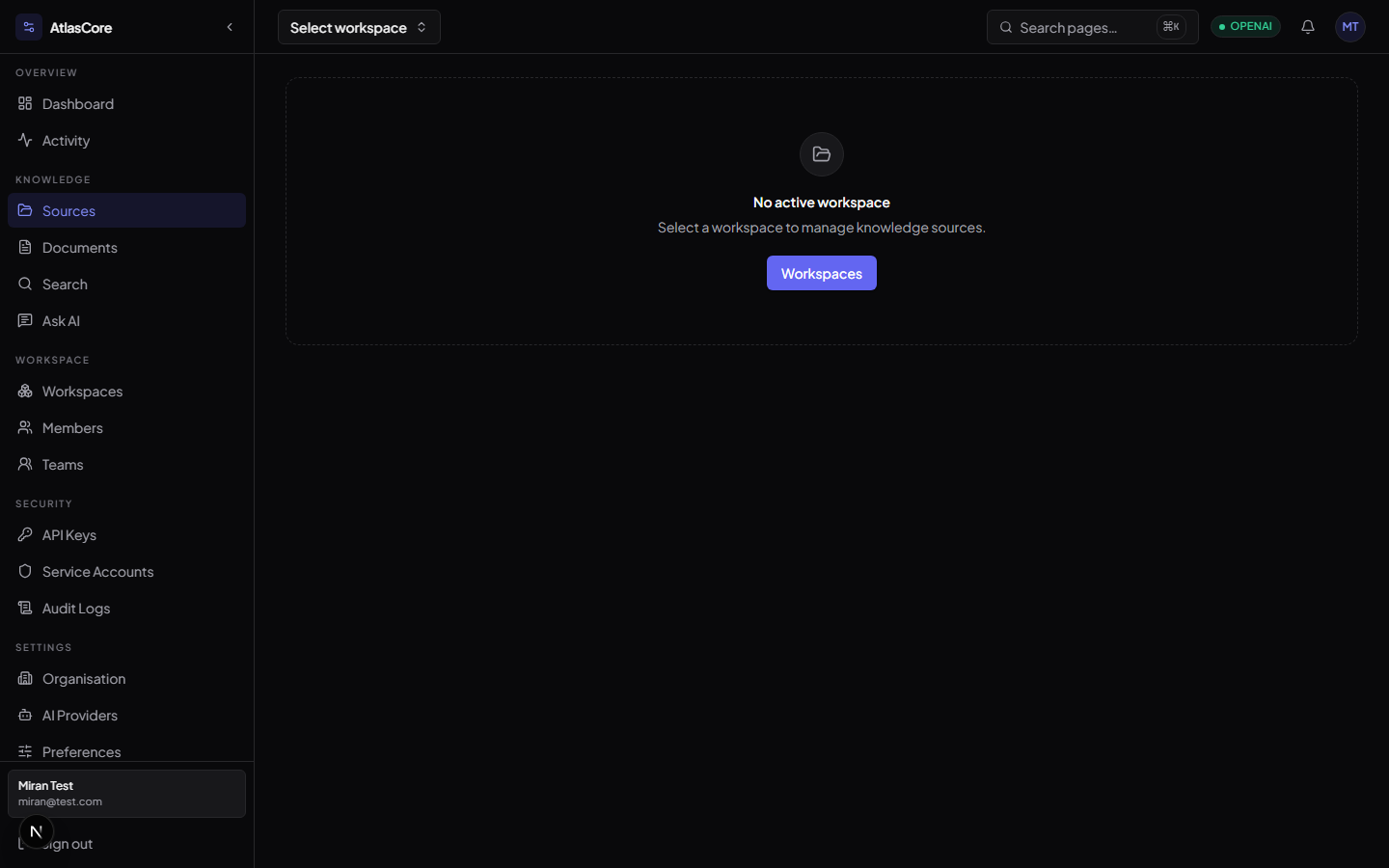
UI v2 is a major product/UX iteration: dark engineer-tooling aesthetic, persistent grouped sidebar, workspace selector, command palette, provider status, and polished surfaces for day-to-day workspace work. Users can list and create workspaces, receive administrator membership on create, switch workspace context, and continue into workspace-scoped features without manually entering UUIDs. Ask AI shows citations/evidence and represents abstention or weak-evidence states clearly, including sanitized provider failure states.
Surfaces: dashboard · workspaces · knowledge sources · documents · search · Ask AI · members · teams · API keys · service accounts · audit · organisation settings · AI provider settings · preferences
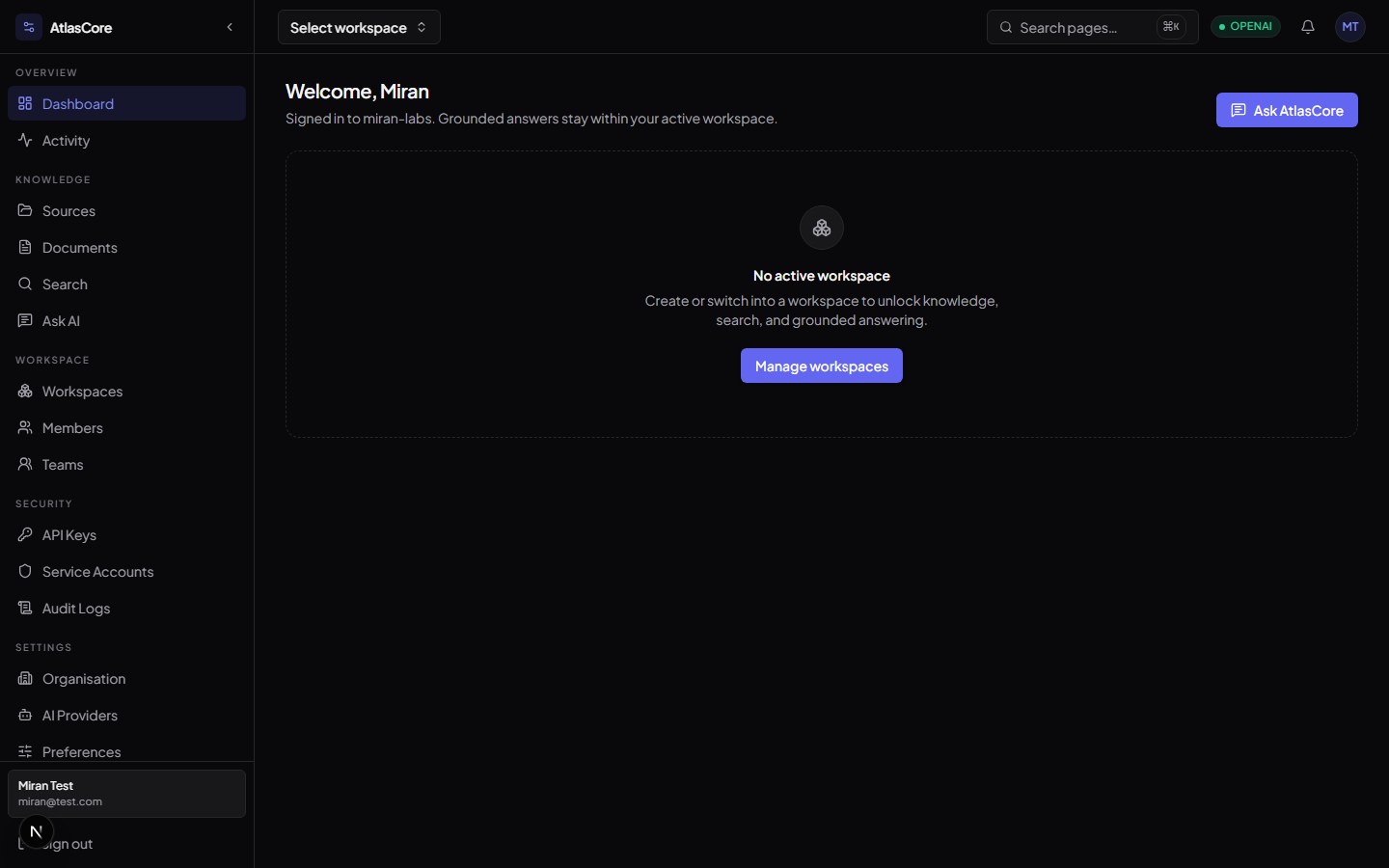
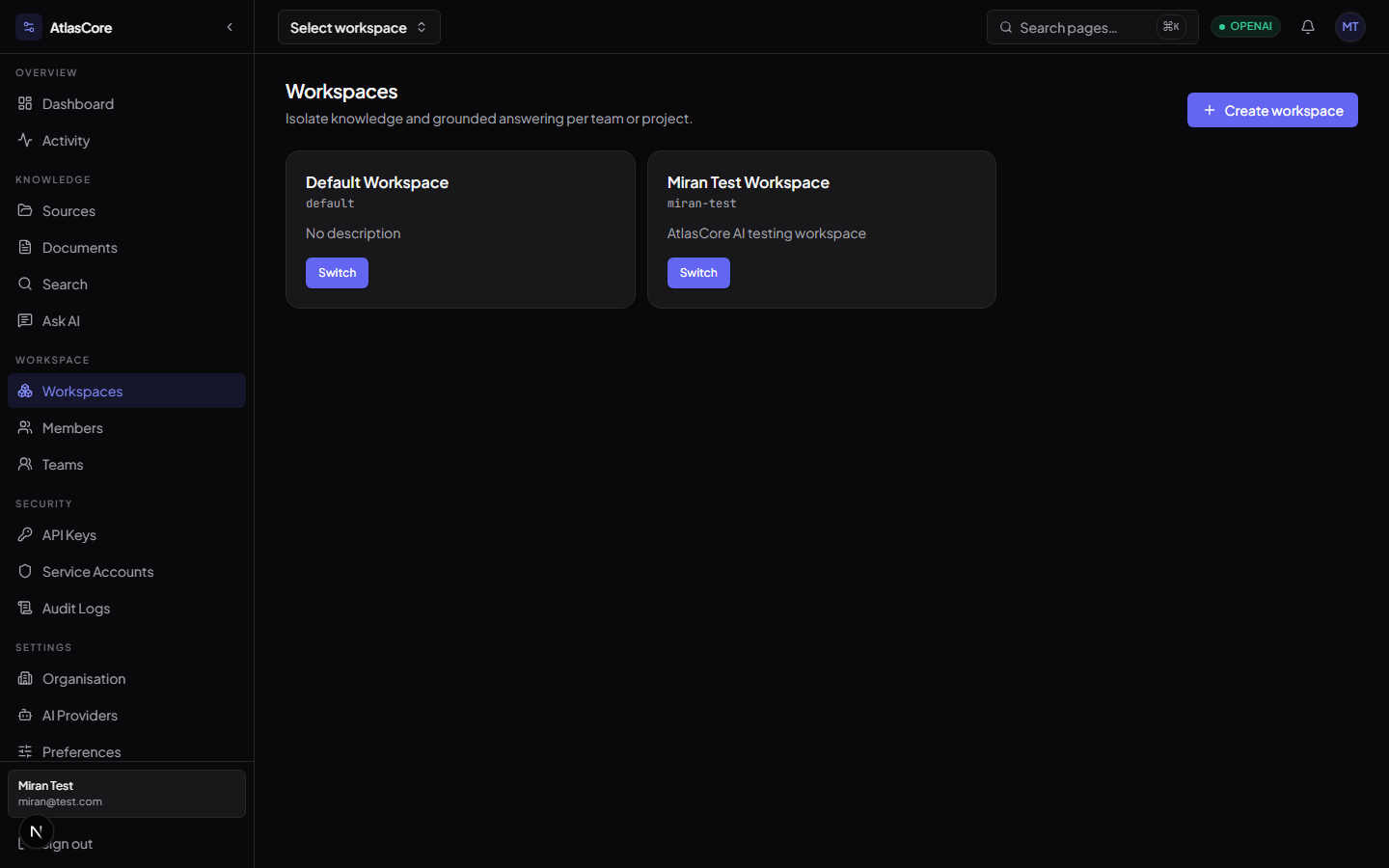
Latest verified UI commit: 9d62e33 — feat: ship AtlasCore UI v2 and workspace experience. An earlier phase-2d baseline tag still exists separately and does not contain UI v2.
verification
Verification covers backend tests, targeted database/security checks, deterministic evaluations, static analysis, and frontend quality gates. FORCE RLS, the restricted runtime role, and live membership validation remained intact through the UI v2 verification pass.
- Backend tests
- 717 passed · 0 failed
- Targeted DB/security
- 216 passed
- Deterministic evals
- 46/46 · 100%
- Ruff
- clean
- mypy strict
- clean · 90 source files
- Frontend
- lint + type-check + Vitest + build passed
tradeoffs / limitations
The verified surface is an engineering-complete UI v2 platform for knowledge, retrieval, and grounded workflows — not a claim of large-scale production deployment. The following are explicitly not shipped:
MCP · safe analytics SQL · workflow engine · tool registry · human approval gates · Gemini integration · large-scale production deployment
stack
Python · FastAPI · PostgreSQL · FORCE RLS · pgvector · Redis · Next.js · TypeScript · OpenTelemetry · pytest · Vitest
repository
Public repository: github.com/miransec/atlascore